

This easy dinner roll recipe comes straight from my Grandma’s recipe box and is made with buttermilk and yeast for rolls that are unbelievably soft, buttery, and melt in your mouth! Perfect for Thanksgiving or Christmas dinner, or any time you’re craving soft, buttery rolls.
⭐️⭐️⭐️⭐️⭐️
Lesley says: “These are the best rolls. I have made them for the past few Thanksgiving and Christmas dinners and everyone loves them. I do the overnight method and make 24 rolls out of this recipe…4 x 6 smaller rolls in the same size pan.”

These Are the Best Dinner Rolls EVER

I’m not going to lie. I’ve been intimidated to make rolls from scratch. I had so many questions to answer I didn’t dare take the first step to start.
But after tinkering with my Grandma MJ’s recipe for yeast rolls, I can say we’ve now realized roll nirvana. That’s why this dinner rolls recipe post is so comprehensive, with tips and easy instructions that gave me the confidence to master the best homemade yeast rolls.
Soft and tender and so easy to make, these are everything you want a roll to be. While heavenly on their own with a generous smear of salty butter, these rolls are perfect for sopping up potatoes and gravy served with your Thanksgiving dinner, the last licks of Sunday’s pot roast dinner, or for your Christmas, alongside some glazed ham. They also make killer post-holiday sandwiches.
In my book, these are basically and quite simply the best dinner rolls ever.
Enjoy!


Ingredient Notes
Most rolls have the same key ingredients. In this recipe, you’ll find the usual suspects, plus one magical ingredient my Grandmother swore by.
The full recipe, with amounts, can be found in the recipe card below.
- Buttermilk — The magical ingredient that isn’t in every roll recipe but probably should be because it yields the most tender, flavorful rolls. Just be sure to use full fat for optimal flavor and texture.
- Sugar— For sweetness, though you can use honey (just cut it down to ¼ cup, since honey is sweeter than sugar).
- Butter — Lends fat and flavor to these dinner rolls.
- Eggs— Incorporated into the dough and also used for brushing the rolls before baking. This helps give them that lustrous, golden hue.
- All-purpose flour — A key ingredient to achieving these supple yeast rolls.
- Instant yeast— I use RapidRise yeast because it saves time and you don’t have to bloom it in water first to activate it.
- Flaky sea salt — For topping, such as Maldon.
- Optional mix-ins and toppings — You could add fresh or dried herbs, garlic, or cheese to the dough if you like, or sprinkle your rolls with poppy seeds, sesame seeds, everything bagel mix, or herbs and cheese before baking.

How to Make the Fluffiest Buttermilk Dinner Rolls
Heidi’s Tip: Plan ahead to allow enough time for the dough and shaped rolls to rise. Start these rolls around lunchtime when making them for dinner (start in the morning if you’re having a mid-afternoon meal).
Step 1: Warm the liquids before adding them to the yeast
The mixture should be warm but not hot and read somewhere between 100°F and 110°F so the hot liquid doesn’t kill off the yeast (I use a digital thermometer to check the temperature).
If your mixture registers hotter than that, let it cool on the counter for a bit, or pop it in the fridge for a couple of minutes, then recheck with your thermometer.

Step 2: Make Your Dough
Add the flour, yeast, and salt to the bowl of a stand mixer fitted with the dough hook. Add the buttermilk mixture, followed by 2 eggs.
Mix on medium speed for about 5-7 minutes, or until the dough is smooth, elastic, and comes free from the sides of the bowl.
Heidi’s Tip: If you don’t have a stand mixer and dough hook, you can mix this in a large bowl with a spatula or wooden spoon, and then knead with your hands for about 10 minutes.

Step 3: Let the dough proof aka rise
Brush the inside of the largest bowl you have with room-temperature butter (you could use cooking spray, but we’re going for buttery rolls, so I like using butter), and place your dough in the bowl.
Cover with a kitchen towel and place in a warm spot in the kitchen or an oven that’s been warmed for just 1 minute then turned off. Proof the dough for about 1 hour, or until it has doubled in size.

Step 4: Portion the Dough
Use a bench scraper or sharp, heavy knife to divide the dough in half. Cut each half in half and those halves in half. You’ll want to have 15 equal pieces of dough (for 15 rolls).
I end up with one extra roll that I portion out to the slices so the rolls all weigh the same. I recommend weighing each roll with a kitchen scale to ensure they’re all the exact same size. I weigh mine out so each is about 70g or almost 2.5 ounces. If you have any dough left over, cut off little pieces and add them to each roll.
Another way to portion the dough is to weigh your entire ball of dough before cutting, then divide that number by 15 to get the most precise weight for each roll.

Step 5: Shape Your Rolls
Shaping yeast dinner rolls might feel tricky, but it’s really easy once you get the hang of it. The key thing is to allow some friction between the dough and your work surface.
I’m a visual learner, so watching this video really helped me grasp the technique. Start with a lightly floured work surface. You want to be sure to cup your hand around the dough ball, resting the side of your hand on your work surface as you gently roll in quick, tight, circular motions.
Heidi’s Tip: As you’re rolling, cover your other dough portions with a kitchen towel so they don’t dry out.

Step 6: Proof Your Rolls
Brush a 9×13-inch baking pan with softened butter. Then arrange each of your rolls in there, 5 across. Cover with a dish towel and let sit someplace warm for the rolls to proof (I like stashing mine in the microwave), for 1 hour (if the rolls have not doubled in size by then, you may need to allow another 30 minutes of proofing time).

Step 7: Brush and Bake
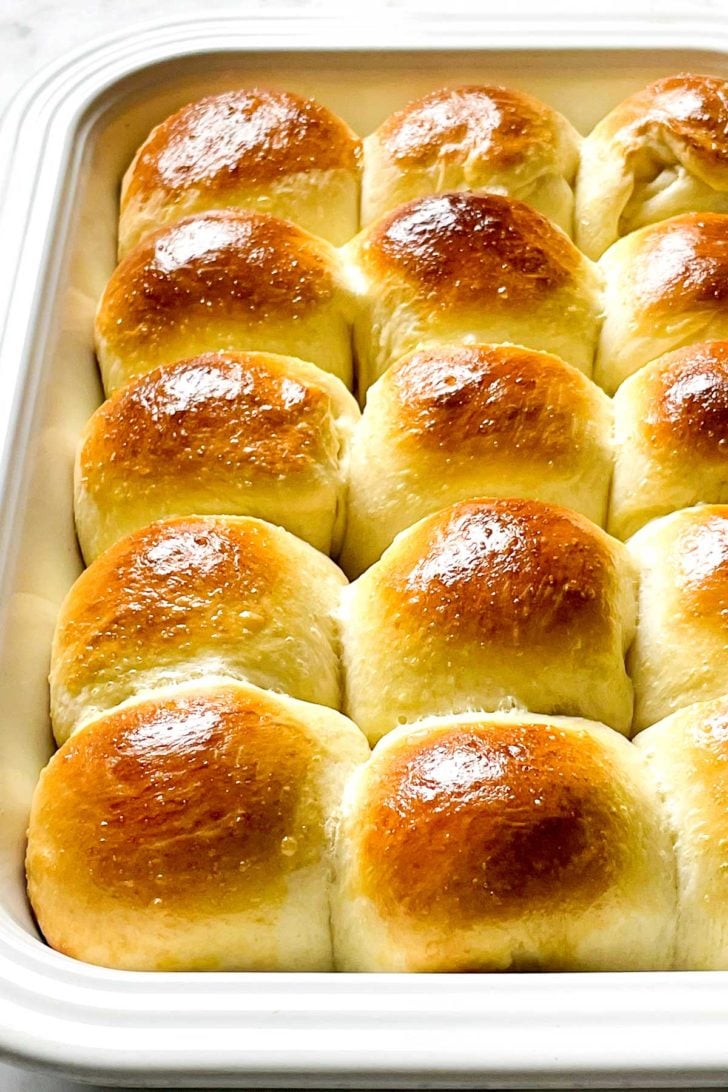
Once the rolls have finished proofing, preheat your oven to 350°F. Break the remaining egg into a small bowl and whisk well. Brush each roll with the egg wash (you will not use all of it) and place the rolls in the oven to bake for about 20-23 minutes or until golden brown.
Once the rolls are done, brush them with more softened butter and top with a sprinkling of flaky sea salt.
Heidi’s Tip: I like brushing these with an egg wash as opposed to melted butter because it gives the rolls much more color and sheen.
Troubleshooting and FAQs
This recipe uses rapid-rise or quick-rise yeast. I prefer rapid-rise because it’s fast-acting and cuts out an extra step. The great thing about rapid-rise or quick-rise yeast is that the particles are finer and they don’t need to be mixed with water and “bloomed” for the yeast to activate. You can simply mix this yeast right into your dry ingredients.
On the other hand, active dry yeast does in fact need to be bloomed first, in order for it to activate. Use this type of yeast instead of rapid-rise if that’s what you have.
If using, here’s how to bloom active dry yeast:
1. Combine the yeast with ½ cup of warm water and 2 teaspoons of sugar.
2. Let it sit for about 10 minutes or until it’s nice and foamy (if it doesn’t get foamy, your yeast may be old and you’ll want to throw it out and start over).
3. You may find when mixing your dough that it’s a bit sticky due to the extra liquid. If so, add more flour, 1 tablespoon at a time.
Any material bowl will work fine for proofing — glass, metal, ceramic, plastic, or stainless steel. For rolls, I prefer using a stainless steel mixing bowl because they retain heat better (so your dough rise will happen a bit faster), and they’re so easy to clean.
Yes, you can let the rolls rise overnight after shaping them. Cover your baking dish with plastic wrap and refrigerate overnight. Remove the wrap then let the rolls sit on the counter for about 30-45 minutes or so before you want to bake them so they can come to room temperature. Note that they might need a bit of extra time in the oven to bake.
This no-fail recipe yields perfectly pillowy, fluffy rolls every time. There are two big things that can prevent your rolls from achieving the fluffy shape and light texture you want them to have.
Your yeast could be old. Since you’re using RapidRise yeast, this recipe doesn’t require you to bloom your yeast (activate it with water and wait for it to get foamy). However, you can use active dry yeast instead, if that’s what you have.
Don’t overwork your dough and allow enough time for it to rise. Overworked dough or not enough rise can cause the rolls to develop too much gluten and turn dense.
Bottom line? Read the recipe carefully before you get started and make sure you have fresh yeast. You’ll be fine!
Your rolls will be golden-brown and should have some color on the bottom of them. If they look done on the top but you aren’t sure, check their temperature. They should be 190°F.

What to Serve With Dinner Rolls
- Juicy Whole Roast Turkey
- Slow Cooker Chicken Cacciatore
- Red Wine Braised Short Ribs
- Mom’s Pot Roast Recipe
- Tuscan Beef Stew
- Grandma’s Fall-Off-the-Bone Country Style BBQ Pork Ribs
If you make this recipe, please let me know! Leave a ⭐️⭐️⭐️⭐️⭐️ rating on this recipe below and leave a comment, take a photo and tag me on Instagram with #foodiecrusheats.

Soft Buttermilk Dinner Rolls Recipe
Equipment
- Stand mixer with dough hook attachment (optional)
- Stainless steel mixing bowl (for proofing the dough)
Ingredients
- 1 ⅓ cup full fat buttermilk
- ¼ cup unsalted butter , plus 3 tablespoons softened butter for the bowl, pan, and brushing the rolls after they’ve baked
- ⅓ cup granulated sugar (or ¼ cup honey)
- 5 cups all purpose flour
- 2 packets rapidrise or quick rise yeast
- 2 teaspoons kosher salt (I prefer Diamond Crystal brand, see note below)
- 3 eggs , divided
- Maldon sea salt , for serving
Honey Butter (Optional)
- ½ cup salted butter
- ¼ cup honey
Instructions
- Add buttermilk, ½ stick of butter, and sugar to a small saucepan and heat over medium low, stirring occasionally with a spatula. Heat just until butter has melted, then remove from heat. Use a thermometer to check the temperature. It should be warm but not hot and read somewhere between 100 and 110°F. If your mixture registers hotter than that, let it cool on the counter for a bit, or pop it in the fridge for a couple of minutes, then recheck with your thermometer. Otherwise, if the liquid is too hot it could kill your yeast.You can also warm your buttermilk, butter, and sugar in the microwave. Just use a microwave-safe bowl and cook 1 minute at a time, stir, check, repeat until your butter has fully melted. Don't forget a microwave shield or your liquid will spatter.
- Add the flour, yeast, and salt to the bowl of a stand mixer fitted with the dough hook. Add the buttermilk mixture, followed by 2 eggs. Mix on medium speed for about 5-7 minutes, or until dough is smooth, elastic, and comes free from the sides of the bowl. (If you don’t have a stand mixer and dough hook, you can mix this in a bowl with a spatula or wooden spoon, and then knead with your hands for about 10 minutes.)
- Preheat oven as low as it will go (mine is 170°F) just for one minute, then turn it off (the oven will be just warm enough for proofing your dough). Brush a large bowl with softened butter. Transfer the dough to the bowl and cover with a kitchen towel. Place in the oven to proof for 1 hour (the dough will double in size).
- Divide the dough in half, cutting it with a bench scraper or sharp knife. Cut each half in half and those halves in half. You’ll want to have 15 equal pieces of dough (for 15 rolls). I recommend weighing each with a kitchen scale if you want, to ensure they’re all the exact same size, about 70g each. If you have any dough leftover, cut off little pieces and add to each roll.
- To shape your rolls, you want to allow some friction between the dough and your work surface. Lightly flour your work surface. Cup your hand around the dough ball, resting the side of your hand on your work surface as you gently roll in quick, tight, circular motions until you have a smooth, round shape (don't worry about the bottom as much). As you're rolling, cover your other dough portions with a kitchen towel so they don't dry out.
- Brush a 9×13-inch baking dish with softened butter. Arrange each of your rolls in the pan in three rows of five across. Cover with a dish towel and let sit someplace warm for the rolls to proof (I like stashing mine in the microwave), for 1 hour (if the rolls have not doubled in size by then, you may need to allow another 30 minutes of proofing time).
- Once the rolls have finished proofing, preheat your oven to 350°F. Break your remaining egg into a small bowl and whisk well. Brush each roll with your egg wash (you will not use all of it) and place rolls in the oven to bake for about 20-23 minutes, or until golden brown. Once the rolls are done, brush them with more softened butter and top with a sprinkling of flaky sea salt.
Make Ahead Options
- Option 1: You can proof the dough overnight before rolling them. Cover the bowl with a lid or plastic wrap and proof in the refrigerator overnight or up to 24 hours.
- Option 2: You can also let the rolls rise overnight in the fridge. Cover your baking dish with plastic wrap and refrigerate overnight. Remove them from the fridge and keep the plastic wrap on. Let the rolls sit on the counter for about 30-45 minutes or so before you want to bake them so they can come to room temperature. They might need a bit of extra time in the oven.
Notes
Nutrition

GET THE THANKSGIVING PREP GUIDE: Get your FREE Thanksgiving plan, timeline, recipe and menu inspiration, plus all the tips & tricks you need to pull off the best Thanksgiving yet. AND! FREE printable.
We send good emails. Subscribe to FoodieCrush and have each post plus exclusive content only for our subscribers delivered straight to your e-mail box.
Follow me on Instagram, Facebook, Pinterest, for more FoodieCrush inspiration.
As always, thank you for reading and supporting companies I partner with, which allows me to create more unique content and recipes for you. There are affiliate links in this post of which I receive a small commission. All opinions are always my own.





Lesley
These are the best rolls. I have made them for the past few Thanksgiving and Christmas dinners and everyone loves them. I do the overnight method and make 24 rolls out of this recipe…4 x 6 smaller rolls in the same size pan.
Aw Lesley! My grandma would be so pleased to hear it! Thank you for the comment and 5 stars!
Barb
These are truly the best rolls I’ve ever made. Thanks for the recipe.
Thank you Barb, so glad you enjoyed the recipe. And thanks fo
whgjg
Good
Glad you approved!
Tammy
I made these rolls for dinner with corned beef and cabbage. They were amazing! My family loved them! I will be making these alot more often!
Hayley
We’re so happy you and your family enjoyed these Tammy!
Amber
I made these last night – 2 batches. I couldn’t get them in the freezer fast enough. My whole family kept sneaking them while they cooled.
Hayley
We’re so happy you and your family loved them Amber!
writemypaperbro
Thanks for the great recipe! Thanks for sharing. If you put about two times less sugar, and after cooking squeeze garlic onto these buns, you get Ukrainian folk buns called “pampushki”. I tried them for the first time in a Ukrainian restaurant (they are usually served with borsch). Who has not heard of the famous Ukrainian borsch with no less famous hfvhushki with garlic? Give it a try, I promise you won’t regret it.
Hayley
Oooh, we’ll definitely have to give Pampushki a try, those sound awesome! :)
Robin Boettcher
Light and buttery!